
Sneek Peek!!!! New Book!!!! OMG I LOVE IT!!!! 🩷🎃
SMUT WITH A SIDE OF PUMPKIN

Chapter One: We Have Everything We Need
And if we don't, perhaps, we've just been looking in the wrong places.
I started my transformation with a pumpkin.
Not a personal trainer, not a particularly expensive wellness retreat, not a complicated new morning routine involving seventeen supplements and a sunrise meditation. A pumpkin.
I was approaching my fiftieth birthday, and somewhere along the way I had decided that I wanted things to change. I wanted to feel stronger, healthier, more capable and, frankly, a little more in control of how I spent my days. I wasn't interested in becoming an entirely different person. I wanted to enjoy being the person I already was, only with a little more intention behind the things I did.
Cinderella had a pumpkin transformed into a carriage. I had a birthday coming up and a rather ambitious idea about what might be possible before I got there.
There was, however, one small problem. I had tried plenty of things before. I knew what it was like to start with enthusiasm, make grand plans, buy the equipment, download the programme, rearrange the calendar and genuinely believe that this time would be different. I also knew what it was like when real life arrived and those plans began to fall apart.
And that's where I want to begin, because I think we've been getting something terribly wrong.
The problem with the perfect routine
Let's take exercise.
Imagine you've decided that you're going to attend a Pilates or strength class every morning. You've found a lovely studio, bought the appropriate clothing and committed to making it part of your life. The class takes an hour. Excellent. One hour of exercise, five days a week. You're going to be a new woman.
Except the studio is fifteen minutes away. You need to get there, find a park, get yourself organised, perhaps wait for the class to begin, complete the workout, visit the bathroom, get changed and drive home. Suddenly, your one-hour workout has consumed considerably closer to two hours.
And you're going to do this every day?
What happens when the children are on school holidays? When someone is home sick? When you go away for a weekend? When you're on holiday? When the car needs servicing, the weather turns dreadful, the school calls, your partner needs something, the grocery shopping needs doing or you simply wake up one morning and don't have the energy to organise the entire production?
The class hasn't changed. Your commitment hasn't necessarily changed. But the circumstances required to make that routine work have disappeared.
Now, perhaps you manage three weeks. Maybe even six. But eventually something interrupts the arrangement, and you miss a class. Then another. Then you find yourself negotiating with yourself about whether to go back.
Before long, the gym membership is another reminder of something you started and didn't finish.
And there's the waste-paper basket.
Not a real one, necessarily, although I'm sure some of us could fill several. I'm talking about the imaginary basket that gets bigger every time we abandon another attempt. The diet we didn't finish, the exercise programme we couldn't maintain, the journal we stopped using, the morning routine that lasted eleven days and the beautifully organised plan that somehow never survived contact with an ordinary Tuesday.
One at a time, these things seem insignificant. Collectively, they can become a rather convincing argument against ourselves.
We begin to anticipate failure before we've even started something new. We might still get excited about an idea, but there's a little voice in the background reminding us how many times we've done this before. And eventually, we start believing that consistency is something other women have.
Perhaps they're naturally disciplined. Perhaps they're more organised. Perhaps they have more time, more support, fewer interruptions or a mysterious ability to get everything done before breakfast.
Or perhaps they've simply found ways of doing things that fit into the lives they actually live.
Because here's the uncomfortable truth: you can be completely committed to changing your life and still have a routine that is practically guaranteed to fail.
Not because you're lazy. Not because you lack ambition. Not because you don't want it badly enough.
Sometimes the problem is the plan.
We need to stop designing routines for the imaginary version of ourselves who has two uninterrupted hours every morning, and start designing them for the woman who actually gets up, gets everyone organised, goes to work, runs a household, answers messages, makes decisions, looks after other people and occasionally wonders whether she's had a cup of tea today.
That woman deserves a system that works too.
Enter SMUT
Now, before you clutch your pearls, let's talk about SMUT.
We've been taught that smut isn't for good girls. Smut is naughty. It's a little bit inappropriate, perhaps something you'd read behind a closed bedroom door or keep tucked away where the children won't find it.
Well, we're changing the narrative.
SMUT stands for Smallest Measurable Unit of Time.
And while I appreciate that this might not be the acronym your primary school teacher would have recommended, I rather like it.
Because SMUT is about finding the smallest amount of time in which you can complete an action that contributes to something you want to achieve.
Not an hour. Not half an hour. Not an entire afternoon.
Sometimes twenty seconds.
That's it.
Twenty seconds might sound ridiculous when we've spent years being told that meaningful change requires enormous amounts of time, effort and commitment. But we're not trying to replace every substantial activity in our lives with twenty-second alternatives. We're trying to remove the enormous barrier between doing nothing and doing something.
And there's a very important distinction.
We're not making our ambitions smaller. We're making the starting point smaller.
Imagine a woman who wants to become stronger. She has a pair of dumbbells and decides that every morning, after her shower, she'll lift them for twenty seconds.
She starts with bicep curls.
Twenty seconds. Finished.
She puts the weights down, takes a breath and thinks she could probably manage another twenty seconds. So she picks them up again, this time for tricep extensions.
Another twenty seconds.
Then she thinks, well, she's already standing there, the weights are already in her hands and she's not particularly busy for the next twenty seconds. So she does some overhead shoulder presses.
And that's it.
In less than a minute, she's completed three short sets of upper-body movements. She hasn't completed a full strength-training session, and we're not going to pretend she has. But she has done something that matters.
She has lifted weights today.
Tomorrow, she lifts weights again.
And the next day, she does it again.
Something quite interesting has happened here. She's gone from being a woman who doesn't lift weights to being a woman who lifts weights every day.
Now, someone might say, "But it's only twenty seconds."
And my response would be: do you lift weights every day?
No?
Then perhaps let her enjoy her twenty seconds.
This isn't a competition. We're not trying to impress the people standing on the sidelines, and we certainly don't need their permission to begin.
We're interested in what happens inside our own heads when we repeatedly do something we previously believed we couldn't maintain.
We have created evidence.
Not a promise to ourselves, not a new year's resolution, not an intention to start next Monday. Actual evidence.
We did it today. We can do it tomorrow. We have already demonstrated that we are capable of doing the thing.
The behaviour may be small, but the significance of that evidence is not.
Repeated actions help reinforce the neural pathways associated with those behaviours. We begin to make the action familiar, reduce the amount of negotiation required to get started and build an increasingly reliable association between ourselves and the thing we're doing.
We don't have to wait six months to start thinking of ourselves differently.
We can change the truth of what we say about ourselves today.
I lift weights every day.
That's a true statement.
And I rather like that.
We have everything we need. We just need to use it differently.
Here's where things become even more interesting.
What if the reason we struggle to maintain routines isn't simply that they take too much time? What if it's also that we keep trying to introduce entirely new activities into lives that are already full?
Think about your morning.
You get up. You go to the bathroom. You shower. You apply your skincare, perhaps some leave-in conditioner, get dressed, do your makeup, make a coffee and get on with your day.
These things are already happening.
You don't need to find an extra hour to shower. You don't need to schedule a separate appointment to put your makeup on. You don't need to remind yourself to brush your teeth.
They're existing routines. They have an established place in your day.
So what happens if we start looking at them differently?
Perhaps while you're waiting for your leave-in conditioner to do its thing, you pick up your dumbbells and do twenty seconds of bicep curls.
Perhaps while you're standing at the makeup bench, you do some tricep extensions.
Perhaps before getting into the shower, you put your hands on the floor and hold a plank.
Perhaps while the kettle boils, you do some calf raises.
You're not adding another appointment to your calendar. You're not creating a completely new morning routine. You're simply attaching a small action to something that was already going to happen.
And that is one of the most important principles of this book.
We don't need to build a new life to start improving the one we have.
We can use the time that's already there.
We can use the spaces between things, the little pauses, the waiting periods and the transitions that happen throughout an ordinary day.
The shower is already happening. The conditioner is already working. The coffee is already brewing.
We simply give those moments another job.
And before anyone starts imagining an elaborate routine involving seventeen exercises, three meditation sessions and a complicated sequence of bathroom movements, please don't.
We're starting small.
Very small.
The objective isn't to create another complicated system that becomes impossible to maintain. It's to find one existing routine, attach one small action and see what happens.
We have everything we need to begin.
The four anchors
There are four ideas that underpin everything we're about to do.
The first is capability. We need to recognise that we are capable of doing things, and we need to give ourselves actual evidence of that capability. We don't need to wait until we've achieved the final result to acknowledge that we've started becoming the person who does the thing.
The second is time. We need to stop looking exclusively for large blocks of uninterrupted time and start recognising the opportunities that already exist throughout our day. Twenty seconds is time. A minute is time. Five minutes is time. We don't have to wait for an entire afternoon to become available before we can do something useful.
The third is SMUT itself. We find the smallest measurable unit of time in which we can complete an action that contributes to something we want. It gives us a starting point that is achievable, repeatable and within our control.
And the fourth is an existing routine. Rather than immediately creating something new, we attach our SMUT to something that is already part of our day.
These four ideas work together.
We identify something we want to do. We find a small enough action to make it achievable. We attach it to an existing routine. Then we repeat it.
That's our starting point.
Not a complete lifestyle overhaul. Not a list of twenty new habits. Not another programme that requires us to rearrange our entire lives.
One thing.
One small action.
One opportunity to prove to ourselves that we can do what we said we would do.
Consistency isn't supposed to be complicated
I think we've also made consistency unnecessarily difficult.
We tend to associate it with doing the same substantial activity at the same time, in the same place, every single day. And while that arrangement works beautifully for some people, it isn't the only way to be consistent.
Consistency is about maintaining a behaviour, not necessarily maintaining the exact same circumstances around it.
If you usually walk for an hour but today you only have ten minutes, you can walk for ten minutes.
If you usually lift weights for half an hour but today you only have time for your smallest SMUT, you can do that.
If you're travelling, you can adapt. If the children are home, you can adapt. If your usual routine isn't available, you can find another opportunity.
This doesn't mean every version of an activity produces the same result. It means that the existence of a less-than-perfect day doesn't have to mean the complete absence of the behaviour.
And that's a rather different way of approaching our lives.
We don't need to be perfect. We need to become adaptable.
We need to build routines that can bend without breaking, and we need to stop treating every interruption as evidence that we've failed.
Because the woman who can maintain a small behaviour through ordinary life is building something rather valuable. She's building reliability.
And reliability creates opportunities for progress.
Twenty seconds can become forty. Forty can become a minute. A minute can become a longer session. Eventually, you might find yourself wanting to do more, because you've removed the enormous psychological hurdle of getting started.
But here's the important part: the twenty-second minimum doesn't disappear just because you've become capable of doing more.
It's still there on the days when that's all you have.
This is not about doing less with your life
I want to make this particularly clear.
SMUT is not an invitation to lower your expectations, abandon your ambitions or convince yourself that doing the bare minimum is always enough.
Quite the opposite.
It's about making our ambitions more achievable by changing the way we approach them.
We can still want to become stronger. We can still want to improve our health, learn something new, organise our homes, build a business, develop a creative practice or finally finish the project we've been talking about for three years.
We can still want big things.
But we don't have to make the beginning of those things enormous.
In fact, I'd argue that the bigger the ambition, the more important it becomes to have a starting point that is easy to access.
We don't need another elaborate plan that only works when everything goes perfectly.
We need a minimum that works when life is ordinary.
And sometimes, ordinary is considerably more challenging than we give it credit for.
There will be days when you'll do your twenty seconds and move on. There will be days when you'll do considerably more. There will be days when you'll forget, get interrupted or simply decide that something else needs your attention.
We're not trying to manufacture a perfect life in which nothing ever goes wrong.
We're learning how to keep moving within the life we already have.
And perhaps that's the biggest change of all.
We stop waiting for the right circumstances to become the woman we want to be.
We start being her now.
So, where's your pumpkin?
I suppose we should return to the pumpkin.
Cinderella's pumpkin had a rather spectacular transformation. One minute it was a vegetable, the next it was a carriage, and eventually it was a vegetable again.
A fairly impressive evening, all things considered.
My own pumpkin was perhaps a little less magical, but it did remind me of something important.
Transformation doesn't have to begin with a grand gesture. It doesn't require us to become someone else overnight. It can begin with a decision to do something differently, followed by one small action that makes that decision real.
And you don't need a fairy godmother.
You don't need a perfect morning, a new wardrobe, a gym membership or another expensive programme.
You need to decide what you want to change, find your smallest measurable unit of time and give it a place in the life you're already living.
Twenty seconds.
Then another twenty tomorrow.
And another the day after.
Not because twenty seconds is the ultimate destination, but because it gives you somewhere to begin.
And once you've begun, you have something you didn't have before.
Evidence.
Evidence that you can do the thing. Evidence that you can repeat it. Evidence that the woman you thought you might become is already beginning to emerge.
So let's stop filling the waste-paper basket.
Let's stop waiting for Monday, the first of the month, the new year or the magical day when everyone else leaves us alone and we finally have two uninterrupted hours.
Let's find one thing.
One SMUT.
And let's do it.
Welcome to SMUT.
Good girls, bad girls, busy girls, tired girls, women who have abandoned seventeen gym memberships and women who are simply ready to try something different.
There's room for all of us.
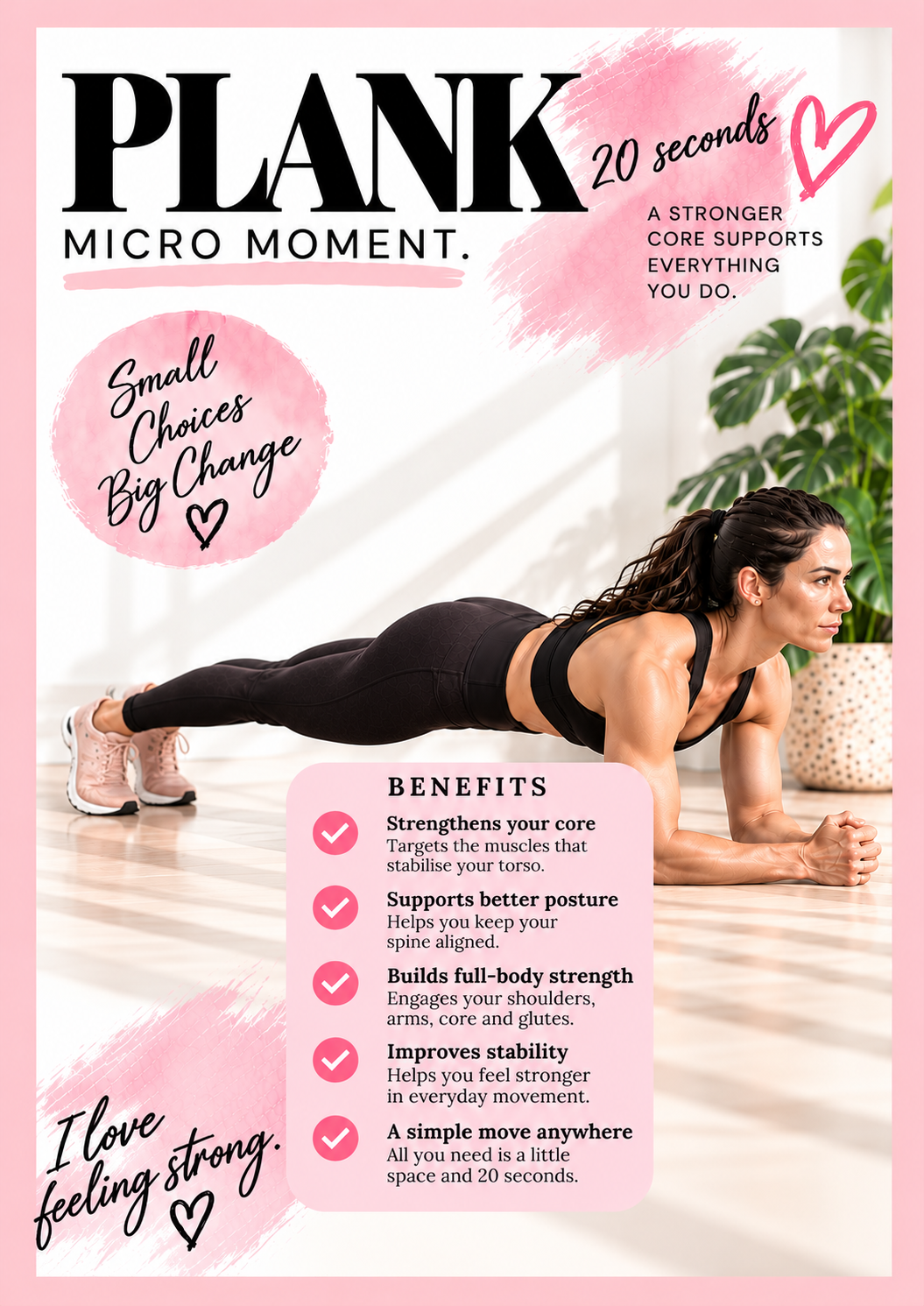
YOUR FIRST SMUT: THE PLANK CARD
A little something to get you ready for the ball.
Right. Enough talking. It's time to give you something to do.
And because we're feeling generous, we're going to start with something that requires absolutely no equipment, no gym membership, no special clothing and, preferably, no audience.
Your first SMUT is a plank.
Here's what you're going to do.
Grab your phone. Open the timer. Set it for 20 seconds.
Find a clear space on the floor, get yourself into a plank position, press start and hold.
Twenty seconds.
That's your first SMUT.
When you're finished, that's it. You can get up, congratulate yourself and carry on with your day. Or, if you're feeling particularly enthusiastic, you can have another go.
But here's the important part.
Do it again tomorrow.
And the day after that.
And the day after that.
You don't need to make it longer. You don't need to add another exercise. You don't need to turn it into a complicated new fitness programme. For now, we're simply establishing that you are a woman who does a plank every day.
I do mine on the bathroom floor, with a little push-button timer sitting beside me. Naked.
Ooooh. Now there's some SMUT for you.
When I first started, I couldn't even hold a plank for twenty seconds. I'd get down, start the timer and discover that twenty seconds was considerably longer than I had anticipated.
But I kept doing it.
And I'm pleased to report that I can now hold one for forty seconds.
That's double my original SMUT.
I haven't magically become a different person. I've simply given myself the opportunity to practise, repeat and improve.
And that's what I want you to experience.
Don't worry about what anyone else can do. Don't compare your twenty seconds with somebody else's two minutes. You're not competing with the woman next door, the fitness influencer on Instagram or the person who looks like they were born holding a plank.
This is your floor, your timer, your twenty seconds and your body.
If twenty seconds is too much today, make it ten. If you have a wrist, shoulder or back issue, choose a comfortable alternative or get appropriate guidance before attempting the exercise. We're interested in building something sustainable, not proving a point at the expense of your body.
And if twenty seconds is easy? Lovely. Enjoy it. You can always do more, but you don't have to.
Your only assignment is to show up again tomorrow.
Because somewhere between today and the next few days, something rather wonderful might happen.
You might stop thinking of yourself as someone who is trying to exercise.
You might start thinking of yourself as someone who exercises.
And that, Cinderella, is how we get ready for the ball.
Now put your phone down.
The pumpkin can wait.
You've got a plank to do.... 😆